

All-on-4 Dental Implants in Puerto Vallarta: Cost, Process and Healing Timeline
For patients missing most of their teeth, or living with failing teeth and loose dentures, a full-arch restoration can change daily life. It means eating steak and corn on the cob again, laughing without hiding your mouth, and no more adhesives. In the United States and Canada, it's also one of the most expensive treatments in dentistry, which is why many patients look to Mexico.
This guide covers how the procedure works, what it costs, how many trips you need, and how to decide if it's right for you. All-on-4 dental implants Puerto Vallarta
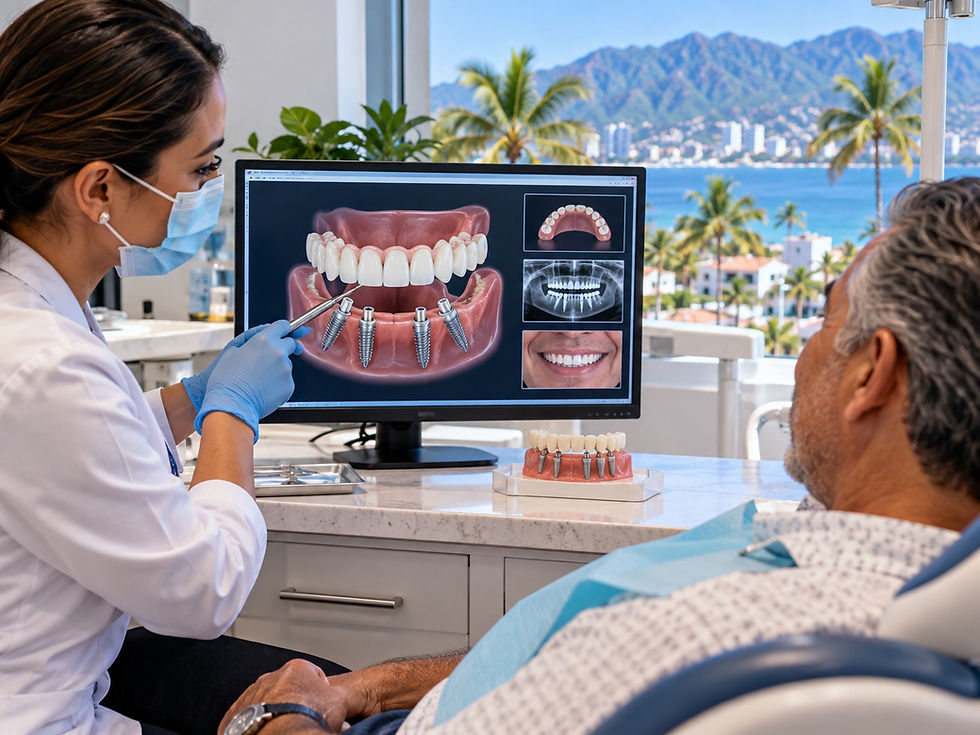
What to Expect From All-on-4 Dental Implants in Puerto Vallarta
All-on-4® is a technique that replaces a full arch of teeth with a fixed bridge supported by four dental implants. The two front implants are placed straight, and the two back implants are angled to make the most of the available bone. That angle often lets patients avoid bone grafting, which shortens treatment time and lowers cost.
The bridge is fixed in place. Only your dentist can remove it, so it feels and works much more like natural teeth than a removable denture.
Cost: Puerto Vallarta vs. the United States
In the United States, All-on-4® commonly costs between $20,000 and $30,000 or more per arch, depending on materials and the region. At Éclat Smiles & Aesthetic, All-on-4® dental implants are $10,385 USD per arch.
Before comparing quotes anywhere, ask what's included. Check whether extractions, the CT scan, the temporary bridge, the final prosthesis and follow-up visits are part of the price. The answers matter more than the headline number.
All-on-4 vs. 3-on-6 vs. snap-on dentures
Éclat offers three full-arch options, each with different strengths.
Feature | All-on-4® | 3-on-6 | Snap-On Dentures |
Implants per arch | 4 | 6 | Usually 2 to 4 |
Fixed or removable | Fixed | Fixed | Removable by the patient |
Prosthesis design | One full-arch bridge | Three separate bridges | Denture that clips onto implants |
Bone needed | Less; angled implants often avoid grafts | More bone volume | Least |
Feel | Close to natural teeth | Closest to natural teeth | More stable than a regular denture |
Cleaning | Water flosser and special brushes | Floss and brush much like natural teeth | Removed and cleaned daily |
Price at Éclat | $10,385 USD per arch | $12,985 USD per arch | $6,745 USD per arch |
3-on-6 spreads chewing forces across more implants and often feels the most like natural teeth, but it needs enough bone. Snap-on dentures cost less and are a big step up from a loose denture, but they come out at night. All-on-4® sits in the middle for many patients.
How many trips you need
Full-arch treatment usually happens over two trips.
The first trip usually lasts about a week. It includes a 3D CT scan, any extractions, implant placement, and a fixed temporary bridge. Most patients leave with a full set of teeth, not a gap.
Then comes healing at home, usually three to six months. During this time the implants fuse with the jawbone, a process called osseointegration. You'll wear the temporary bridge and follow a soft diet early on.
The second trip usually lasts about a week as well. Your final, stronger bridge is designed, fitted and adjusted for your bite.
Your treatment plan will confirm the exact timing after your scan, since bone quality and any grafting needs affect the schedule.
Recovery after implant surgery
Expect swelling and soreness for the first few days, usually managed with prescribed medication and cold compresses. Most patients feel ready to walk the Malecón within a few days. Stick to liquids and very soft foods at first, then move to a soft diet for the following weeks as your dentist directs. Avoid smoking, which raises the risk of implant failure. Hold off on pools, hot tubs and alcohol until your dentist clears you.
Who is a good candidate
Good candidates are in reasonable general health with enough jawbone to anchor the implants, whether naturally or after grafting. Smoking, uncontrolled diabetes and some medications, such as certain bone-density drugs, can affect healing. Share your full medical history and medication list at your consultation. If bone is limited, bone grafting may be recommended before or during treatment.
Caring for your new teeth
Implants don't get cavities, but the gums around them can still get inflamed. Clean under the bridge daily with a water flosser and interdental brushes, see a dentist for professional cleanings, and wear a night guard if you clench or grind. With good care, implants can last for decades.
Questions to ask before you commit
Ask which implant system will be used, what the final bridge is made of, whether the temporary is fixed, what the warranty covers, and how follow-up works once you're home. A clear, written treatment plan is a good sign.
A full arch is a big decision, and it deserves a plan built around your bone, your bite and your travel schedule.


Comments